
Jonas
Meta
July 17, 2019
5
min read

The learning phase is the period when the ad delivery system is learning (i.e., getting data) about who to target in combination with your objective, bid and budget.
How does the learning phase work in practice? Let’s say, you’ve just created your ad and put it live. Now what?
Now the system has to learn to which people the ad should be shown in order to get the most desired results (your objective). The way that it does that is through measuring engagement.
Ads are treated like any other piece of content, and the same rule applies to both: it has to be engaging for the user. That’s why the highest paying ad doesn’t always win the auction. It comes down to a combination of the bid and the engagement that the ad is getting. When the algorithm finds a person who engages with the ad, it gives the signal that this type of user is interested and Facebook should be finding more of these people because they clearly enjoy this type of content. When the algorithm has found approximately 50 conversions, it has enough signals to justify scaling distribution within the constraints it has been given. On average, Facebook says it needs 50 conversions to get out of the learning phase. Read more about the learning phase on the Facebook website.
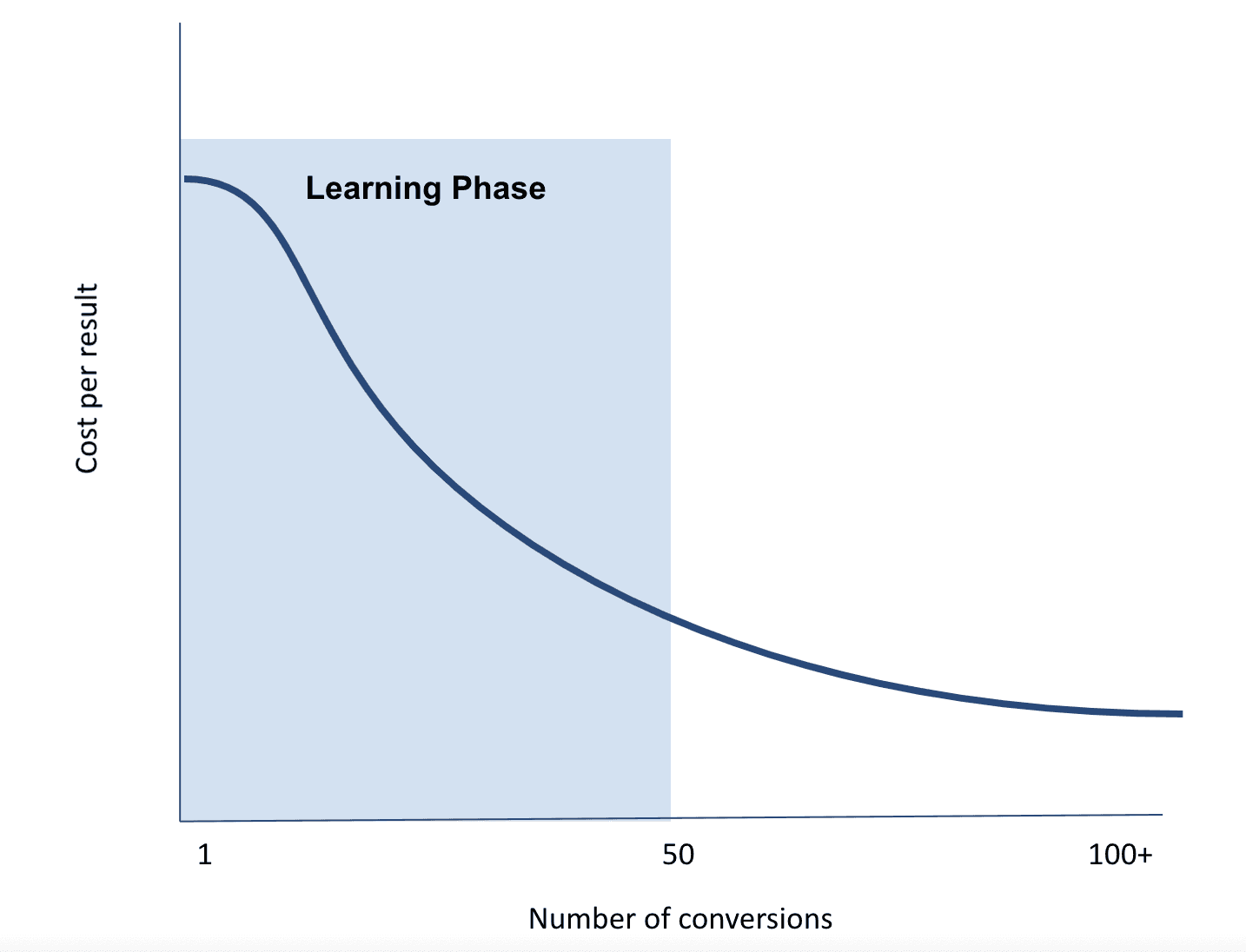
The cost per result goes down the more conversions (data) the system is getting in.
Leave your ads alone!
Leaving your ads alone when they are running is both difficult and important. The learning phase kicks in after each significant edit (and needs approximately 50 conversions to get out).
A significant edit is:
Any change to your targeting
Any change to your creative
Any optimization event
Adding a new ad to your ad set
Pausing your ad set for seven days or longer
Changing your bid strategy
Things that are not seen as significant edits are:
Changes to your ad set spending limit amount
Changes to your bid control, cost control or ROAS control amounts
Changes to your budget amount
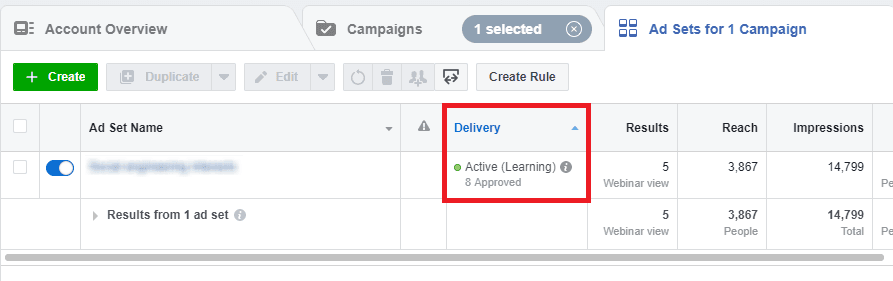
So, once you’ve set up your ads, you should leave them alone (in order to reach 50 conversions and get out of the learning phase). But what if your ads are performing poorly? Should you just sit there and wait while you’re bleeding money? If you want to get the most out of the Facebook ads system, then yes, you should leave them alone. And this is why a good setup is so important. Once you have a good, strong (consolidated) setup in place, you’re in a better position to trust the system and wait until it finds your engaged audience. If your ads are all over the place and you don’t know what you’re doing, it will cause you unnecessary stress and cost you money.
Okay, let’s get back to consolidation. The goal of consolidating your account structure is to get 50 conversions per ad set as quickly as possible, so you’re not spending too much time in the learning phase.
When should you consolidate?
You should be consolidating when your ads have the same value (products, margins, etc.) and creatives but differ in audience and placement. In this case, simply put everything together and let the algorithm find the right people to target.
There are several indicators that you need to consolidate.These are as follows:
Your daily budget is too low. How do you know? You can use this calculation. Average CPA * $50 = minimum budget. For example: if your CPA is $15, then $15 * $50 = $750. Your budget should be $750 minimum (as a total budget).
Your audience size is too low to get enough conversions. Consolidate all ad sets with the same audience into one ad set.
Your audiences are overlapping (how to check overlap).
Your ad sets are split by placements (Facebook, Instagram, Messenger, etc.).
Your ads are spread too thin. Too many ads in an ad set makes it difficult to gather consolidated learnings. What to do: limit the amount of ads to a maximum of six.
When should you choose not to consolidate?
It is often best not to consolidate in the following scenarios:
Your ad sets have different objectives. The algorithm’s goal is to find people who match your objective (people who buy, click, view, etc.). The algorithm can only pick one objective to work on, so consolidating will not be the right thing to do if you have multiple objectives.
Your audiences have different values. The algorithm looks for the cheapest conversions, disregarding the details of who is buying. If you have information about a certain type of audience that the algorithm will not detect, you should not consolidate.
Your locations are valued differently or you need to prioritize one location above another. Again, in this instance, the algorithm will go for the cheapest conversions. It won’t take countries or specific locations into consideration.
If you want to stick with all your ads and ad sets anyway, then make sure you use exclusions for your audience (no overlap, as that will cost you more) and assign a sufficient budget per ad set to get enough conversions.
Written by
Jonas
Jonas is a seasoned Social Media Advertising professional with almost a decade experience working at Meta and Snap. Jonas combines operational excellence from his experience scaling Booking , Disney and Uber on the Meta platforms with leading mid market teams focussing on e-commerce and retail. Jonas believes in the power of great data in, great data out.
More articles by
Jonas