Jonas
Meta
September 21, 2020
4
min read

Having great creatives starts with having great ideas. But it shouldn’t end with just ideas. Meta has made it possible to test out your ideas before putting all of your budget behind them. In this article, you’ll learn how to come up with ideas, how to test them, and how to iterate your ideas based on the feedback you’ll get through real-time data. Probably the most important things you can do when running ads on Meta.
This testing framework is based on three core principles:
Ideation – how to design a creative that drives the best result.
Testing – once the creatives are designed, how can you test them, learn fast, and do so at scale to support a high frequency of creatives?
Iterations – how can you learn from what you’ve tested so far and decide what needs to be changed in the next batch of creatives?
Ideate - produce a creative that performs
How to design a creative that drives the best result.
What/why - Informative hook that explains the product and gets consumer buy-in.
Know the what and why before you begin crafting your campaign.
Communicate the what in first two seconds.
Help the customer visualize the benefit, don’t just tell them what it is.
Experiment with different combinations of what and why.
What would you tell the customer if he/she was standing in front of you?
Answer questions - What are the most important questions your customers have about your product or service (category)?
Connect your product’s benefits to the customers’ questions.
Give clear answers to the questions people have about your product.
Rank these questions and answers in order of importance.
Trust - Use external product reviews to provide reassurance.
Explore your product reviews (or those of your competitor).
Include publications or sites that have featured your product.
Provide data on product usage or audience (if numbers are low, use percentages).
Use 3rd party review sites or marketplaces for adding reviews.
Showcase your brand next to a bigger or more well-known brand.
Call to action - Add a (final) layer of urgency to perform an immediate action.
Use an action verb: “buy now,” “take our quiz,” “subscribe today.”
Time sensitive: “sale ends tomorrow,” “prices go up next week.”
Create FOMO: “last two items,” “30 people are looking at this offer.”
Test - Simple structure to test creatives at scale
How to pick the best creative that sells the best
Account structure
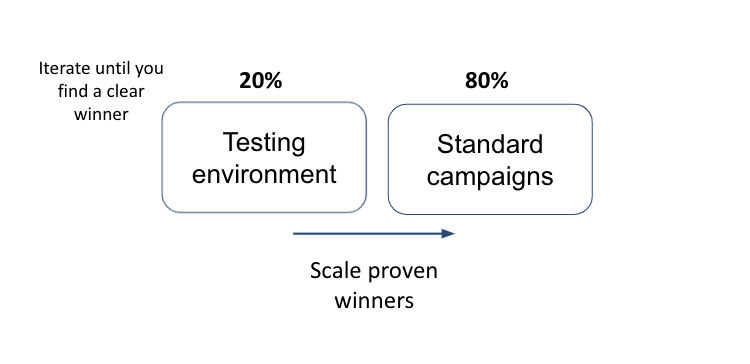
All creative testing is done in the testing environment.
Only the creative that beats the main KPI is scaled to the standard campaign.
Add the winning creative to your current standard campaigns as an additional ad.
If it doesn’t deliver, that’s a sign to iterate and test again.
How to launch new creatives in the testing environment
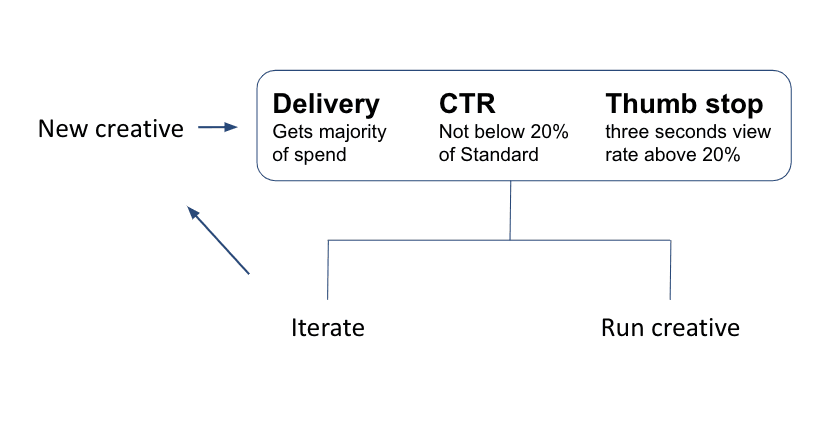
For every new creative look for early success (most common indicators suggested on the left) and the main KPI for standard campaigns (CPA or ROAS target).
If the new creative meets all early success indicators, run the creative until it achieves a stable CPA/ROAS and compare this to your standard campaign. If it doesn’t beat your standard, iterate. If it does, scale to standard.
If the new creative doesn’t meet all early indicators—iterate!
Testing environment campaign structure
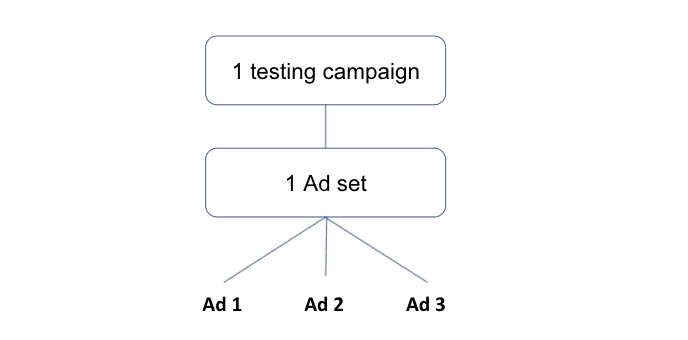
The budget required to get early indicators is typically $200–$300.
The budget required to run a creative (if it passes early indicators): 25*CPA.
Number of ads: Two to three (can be a mix of different iterations).
Targeting: preferably broad. This can also be the same as the usual targeting clients you are using for testing.
KPI: all ads are competing to beat the main KPI (CPA or ROAS).
Iterate - testing concepts and iterating the winners
What have you learned and what will you change
Iterations decision tree
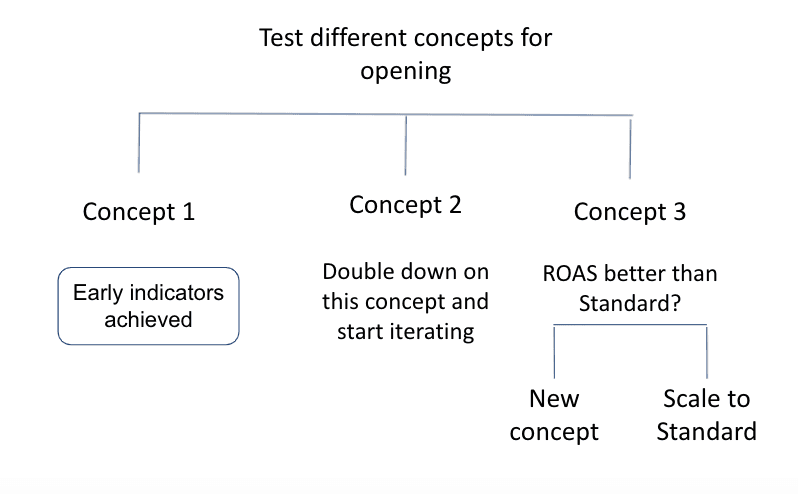
Mainly focus on changing the opening. The first one to two seconds are the most impactful.
Test concepts that are significantly different from each other.
Once you find a winner, start iterating on this specific concept until you reach creatives that beat the main KPI.
What and how to change your creatives

Testing methodology
How to setup your framework
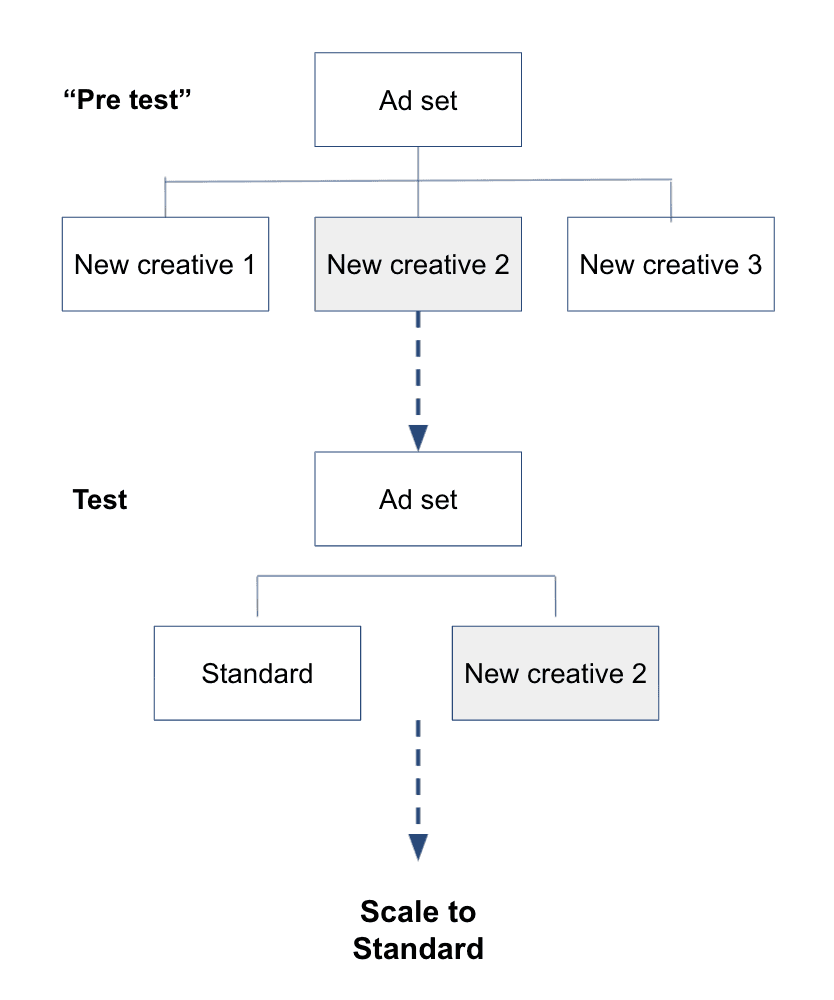
Pre-test
What
Identify the best candidate to run against standard campaign by launching multiple new creatives to get early indicators
Test type
Let the auction selection the winner by
KPI
Delivery of the ad
Budget
50 * CPA
Duration
Seven days
Test
What
Run the best creative from the pre-test against standard in an A/B test environment
Test type
A/B test (learn how to setup)
KPI
Lowest CPA
Budget
Enough to get enough results to show a clear winner
Duration
Seven days
Written by
Jonas
Jonas is a seasoned Social Media Advertising professional with almost a decade experience working at Meta and Snap. Jonas combines operational excellence from his experience scaling Booking , Disney and Uber on the Meta platforms with leading mid market teams focussing on e-commerce and retail. Jonas believes in the power of great data in, great data out.
More articles by
Jonas